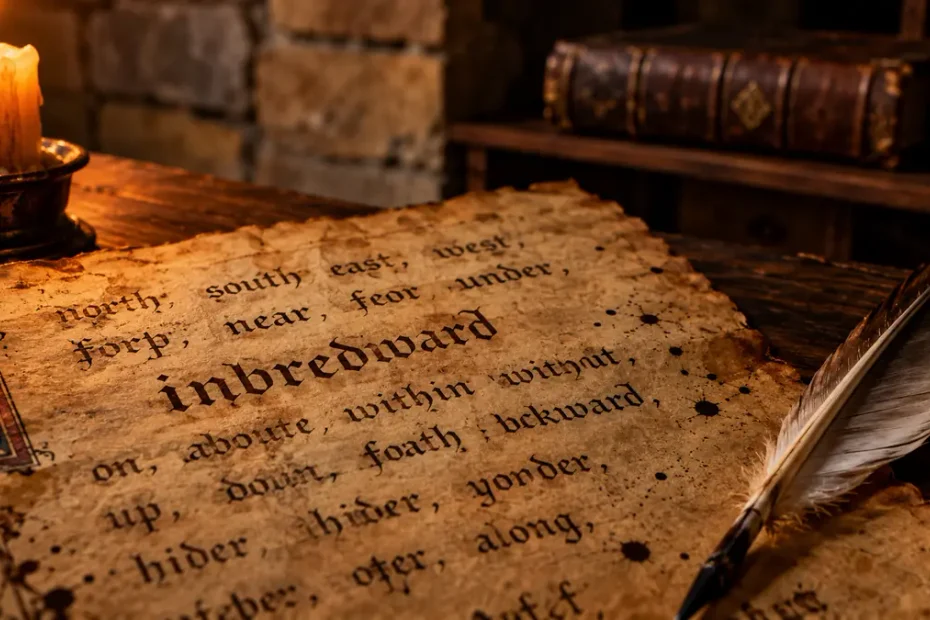
Inbredward: The Forgotten Old English Word for Inward Direction

You stumbled across the word inbredward in an old text and felt completely lost. Most modern dictionaries skip it entirely, leaving you frustrated with zero clear answers. This guide breaks down the full meaning, origin, and real historical usage of inbredward so you finally understand this rare Old English directional adverb without digging through dense academic papers.
What Does Inbredward Actually Mean?
Inbredward functions as a directional adverb meaning “toward the inside” or “inward.” Old English speakers used it to describe movement, attention, or feeling directed toward an interior space — whether physical or emotional.
Think of it as the ancestor of the modern word “inward,” carrying the same core idea but wrapped in an older grammatical structure. The word signals motion or orientation pointing to the center of something.
Where Did Inbredward Come From?
The word traces back to the Old English compound “inbred” (meaning inner or innate) combined with the directional suffix “-ward.” The suffix “-ward” comes from the Proto-Germanic root “*-wardaz,” which indicates direction or orientation.
Anglo-Saxon speakers built directional words by attaching “-ward” to descriptive roots. This same pattern gave English words like “homeward,” “skyward,” and “backward.” The Dictionary of Old English at the University of Toronto documents these compound formations extensively (doe.utoronto.ca).
How Is Inbredward Different From “Inward”?
The two words share the same fundamental meaning, but inbredward carries a stronger sense of innate or natural direction. The “bred” element adds a layer suggesting something born within, not just spatially inside.
Modern “inward” strips away that nuance entirely. It points to direction alone. The older form pointed to direction rooted in nature or origin, making it richer in emotional and philosophical weight.
When Did Writers Use This Word in Literature?
Medieval scribes and early English poets favored inbredward when describing spiritual reflection or the turning of the soul toward God. Religious manuscripts from the 12th and 13th centuries contain the clearest surviving examples.
A monk writing about prayer might describe the mind turning toward the divine center. This usage appears in devotional texts cataloged by the Middle English Dictionary at the University of Michigan (quod.lib.umich.edu).
The word also surfaced in philosophical treatises exploring the nature of conscience and inner moral direction.
Why Did Old English Rely on Directional Adverbs?
Old English grammar demanded precision about spatial relationships. Speakers needed distinct words to describe movement toward, away from, around, and through objects.
Directional adverbs filled this gap. They told the listener exactly where an action pointed without requiring long prepositional phrases. This efficiency mattered in an oral culture where clarity meant survival.
Which Archaic Words Share the Same “-Ward” Suffix?
The “-ward” family is enormous in English history. Many of these words survived into modern speech, while others faded completely.
Homeward — toward home (still common)
Seaward — toward the sea (still used in nautical writing)
Earthward — toward the ground (occasional literary use)
Heavenward — toward the sky or heaven (religious and poetic contexts)
Thitherward — toward that place (fully archaic)
Hitherward — toward this place (fully archaic)
Outward — toward the outside (still common)
Each of these follows the identical construction pattern that produced the Old English directional vocabulary centuries ago.
Why Did This Directional Word Vanish From Modern English?
Language simplifies over time. As English shed its complex inflectional system after the Norman Conquest of 1066, many compound directional words collapsed into shorter forms.
“Inward” replaced inbredward because it communicated the same spatial idea with fewer syllables. The extra nuance of “bred” no longer justified the longer word in everyday conversation.
The Oxford English Dictionary (oed.com) marks the word as obsolete, noting its last recorded uses in the late Middle English period.
How Did English Direction Words Evolve Over Centuries?
Old English direction words were highly specific. A speaker could distinguish between moving toward the inside of a building, the inside of a container, and the inside of the self.
Middle English blurred these distinctions. By the Early Modern period, Shakespeare and his contemporaries relied on a much smaller set of direction words. “In,” “out,” “up,” and “down” absorbed the work that dozens of specialized adverbs once handled.
This consolidation made English faster to speak but less precise about spatial nuance.
How Do Linguists Research Obscure Words Like Inbredward?
Historical linguists reconstruct rare words by cross-referencing surviving manuscripts, charters, and religious texts. They compare spellings across regions and time periods to trace how a word shifted in meaning.
Digital databases have transformed this work. Projects like the Dictionary of Old English and the Middle English Dictionary allow researchers to search millions of words in seconds. A term that once required years of manuscript hunting now surfaces in a simple keyword search.
Did This Word Appear in Religious or Philosophical Writing?
Yes, and this is where the word found its strongest foothold. Christian mystics writing in Old and Middle English used inbredward to describe the soul’s journey toward God.
The concept of turning one’s gaze inward — away from worldly distractions and toward spiritual truth — matched the word’s layered meaning perfectly. The “bred” element reinforced the idea that this inward turn was natural, even divinely planted.
Philosophical writers exploring free will and conscience also reached for the term when describing moral self-examination.
Can You Still Use This Word in Modern Writing?
Absolutely, if your context calls for it. Historical fiction writers, poets, and scholars of medieval literature use inbredward to create authentic period voice.
Dropping the word into casual conversation will confuse most listeners. But in a novel set in 13th-century England or a poem exploring spiritual introspection, it adds texture and historical accuracy that “inward” simply cannot match.
Archaic Directional Words Compared: A Complete Reference Table
| Word | Meaning | Period of Use | Still Used Today | Word Type |
| Inbredward | Toward the inside, innately | Old to Middle English | No | Directional adverb |
| Inward | Toward the inside | Old English to present | Yes | Directional adverb |
| Outward | Toward the outside | Old English to present | Yes | Directional adverb |
| Homeward | Toward home | Old English to present | Yes | Directional adverb |
| Thitherward | Toward that place | Old to Middle English | No | Directional adverb |
| Hitherward | Toward this place | Old to Middle English | No | Directional adverb |
| Heavenward | Toward heaven or sky | Middle English to present | Yes (literary) | Directional adverb |
| Seaward | Toward the sea | Middle English to present | Yes (nautical) | Directional adverb |
| Earthward | Toward the ground | Middle English to present | Rare | Directional adverb |
| Upward | Toward a higher place | Old English to present | Yes | Directional adverb |
Start Exploring the Hidden Layers of English
The English language holds thousands of buried words waiting for curious readers to unearth them. Every archaic term tells a story about how people thought, moved, and prayed centuries ago.
Pick up a Middle English text, search the Dictionary of Old English database, or simply start noticing the “-ward” words hiding in your everyday speech. You will find more the more you search. Language never truly forgets its past — it just waits for someone to ask the right questions.
You Also Like to Read:RN Fundamentals 2016 70 Questions: Complete Study Guide