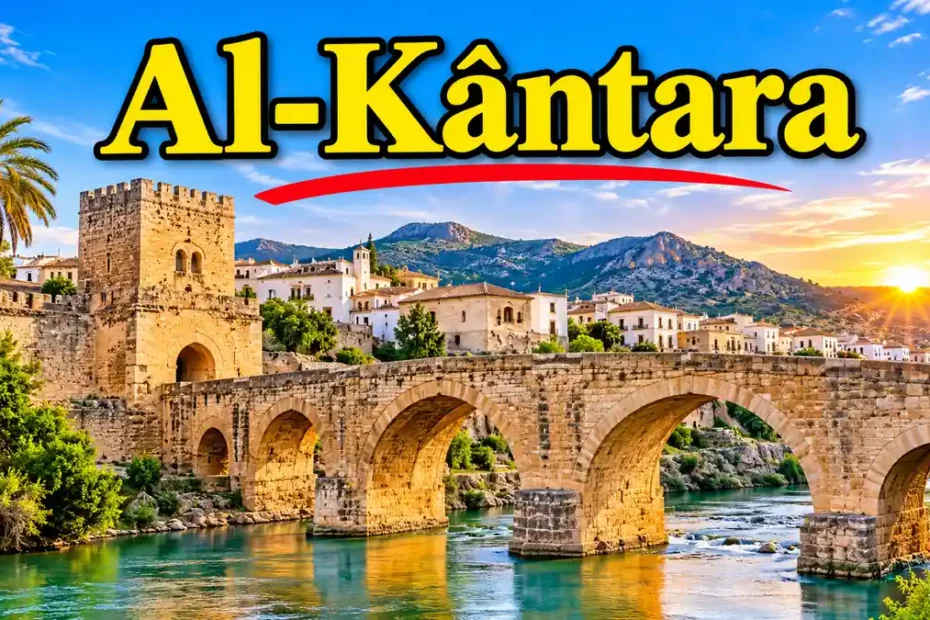
al-Kântara: What the Arabic Word for “Bridge” Still Tells Us
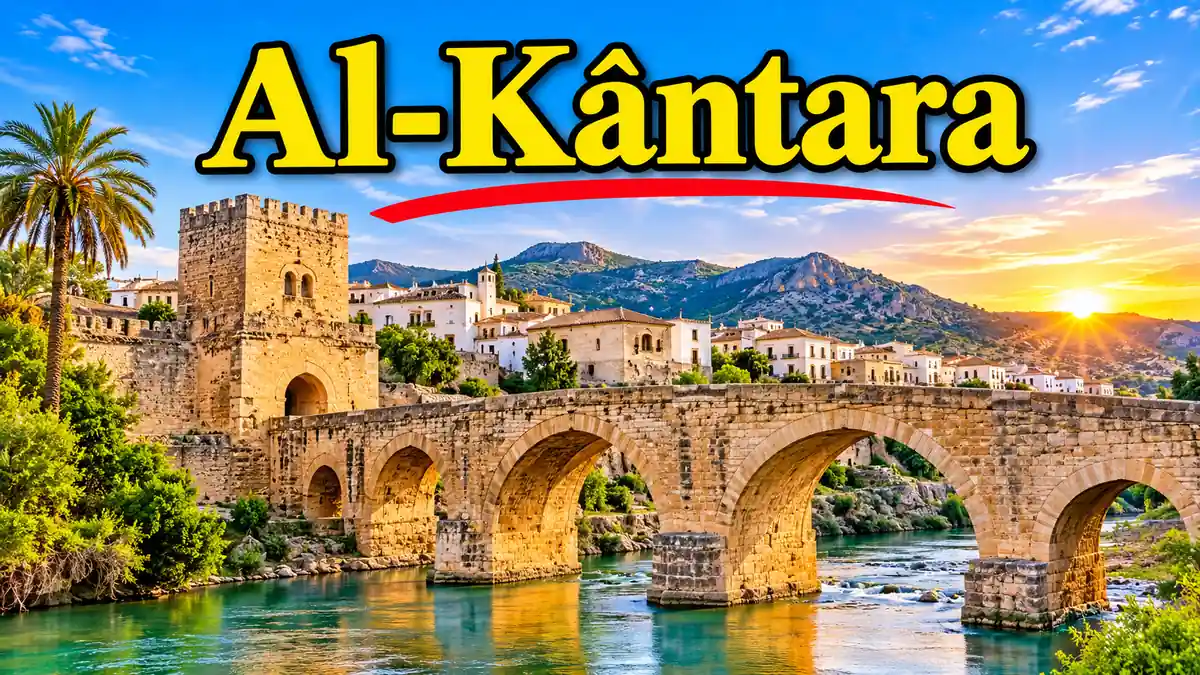
TL;DR: al-Kântara comes from the Arabic al-qanṭara (القنطرة), “the bridge.” The word survives across Spain, Portugal, Sicily, Egypt and Lebanon as a place name — and it gave us surnames, a Sicilian river, and a textile brand you’ve probably sat on.
A single Arabic word for “bridge” is scattered across three continents. You’ll find it on a granite arch in western Spain, on a Lisbon tram stop, on a river in Sicily, and on a road sign beside the Suez Canal. The spelling bends, the accent moves, but the meaning never changes.
That word is al-kântara — a transliteration of the Arabic al-qanṭara. In this guide you’ll learn what it actually means, how it ended up on European maps, which real places still carry it, and how to pronounce it without embarrassing yourself. We’ll also clear up the confusion that makes people searching for a bridge end up looking at car seats.
Quick Overview
- Meaning: al-qanṭara (القنطرة) means “the bridge” — also arch, aqueduct, or dam in classical usage.
- Structure: al- is the Arabic definite article (“the”); qanṭara is the noun.
- Reach: the name appears in Spain, Portugal, Sicily, Egypt, Lebanon, Brazil and the Philippines.
- Best-known example: Alcántara in Cáceres, Spain, named after a Roman bridge finished around AD 106.
- Common mix-up: the Italian company Alcantara sells a suede-like fabric — unrelated to bridges, related only by name.
- Pronounced: roughly al-KAN-ta-ra in Arabic and Spanish, al-KAN-ta-ra in Portuguese with a nasal second syllable.
What Does al-Kântara Actually Mean?
Definition: al-qanṭara (القنطرة, also written qantara) is Arabic for a bridge — specifically a stone or masonry one. Classical dictionaries also use it for an arch, a vault, an aqueduct, or a dam wall.
Break the word in half. The al- at the front is the definite article, the same al- you hear in al-gebra, al-cohol and Al-hambra. The second part, qanṭara, carries the meaning. Its plural, qanāṭir, shows up in old descriptions of aqueducts and multi-arched crossings.
Where the noun itself came from is still argued about. A widely repeated suggestion traces it through Aramaic to the Greek kéntron, meaning a centre point or a compass spike — the kind of thing you’d use to set the curve of an arch. That’s a plausible story, not a settled fact, and most Arabic dictionaries simply treat the root ق-ن-ط-ر as its own thing.
The word also has a little grammar attached. Qanṭara doubles as a verb meaning “to arch over” or “to vault.” So the vocabulary isn’t just about bridges as objects; it’s about the act of spanning a gap. That makes it a fitting name for a piece of engineering, which is exactly how it got used.
How Did an Arabic Word End Up on Spanish and Portuguese Maps?
Muslim rule in Iberia began in 711 and lasted, in shrinking territory, until Granada fell in 1492. That’s nearly eight centuries of Arabic as the language of administration, science and city life in a large part of the peninsula. Place names were part of the furniture, and much of that furniture survived the change of owners.
The pattern is easy to spot once you know it. A river crossing, a fort, a farm, a bridge — each got an Arabic label. When Christian kingdoms took over, the label was often easier to keep than to replace. People had been saying it for generations.
Here’s the clearest illustration. Encyclopaedia Britannica’s entry on the town of Alcántara in Cáceres explains that the walled town was named by the Moors after the Roman bridge it stands beside — al-Qanṭarah, Arabic for “The Bridge.” The name stuck so thoroughly that a knightly order founded there in 1218 took it as its own title. A bridge became a town, and a town became an order of knights.
That’s the mechanism in miniature: an object gets a name, the name outlives the builders, the conquerors, and the language that produced it.
Alcántara, Spain: The Bridge That Named a Town
If you want to see why this particular crossing earned a name, look at the numbers. The Roman bridge at Alcántara crosses the Tagus near the Portuguese border, and it’s been doing that job for the better part of two thousand years.
| Detail | What we know |
| Built | Around AD 104–106, under Emperor Trajan |
| Architect | Gaius Julius Lacer, who signed the structure |
| Material | Dressed granite, laid largely without mortar |
| Structure | Six semicircular arches on five piers |
| Length | Roughly 190–200 metres, depending on how it’s measured |
| Height | Roadway about 45–50 metres above the normal river level |
| Status | Declared a Spanish national monument in 1924 |
Lacer was proud of it. An inscription on the bridge promises, in Latin, a structure that will last “through the unending ages of the world” — and he wasn’t far wrong. What damaged the bridge over the centuries wasn’t weather. It was armies, who blew up arches in 1648, 1760 and 1809 to stop troops crossing, then rebuilt them each time.
The bridge itself is a bridge in the most literal sense, which is why the name fits and why it never drifted. Locals didn’t need a metaphor. They had the river crossing on their doorstep.
Where Else Will You Find the Name?
Iberia is only the loudest example. Once you start listening for qanṭara in its various disguises, it turns up in surprising places.
| Place | Region | What “the bridge” referred to |
| Al-Qantara | Marjayoun, Lebanon | A masonry bridge or crossing point; the word also covers arches and dams |
| El-Qantarah | Suez Canal, Egypt | The historic crossing point on the eastern bank of the canal |
| Alcantara | Sicily, Italy | A Roman bridge near the river mouth, found by the Arabs |
| Alcântara | Lisbon, Portugal | A Roman bridge over the Alcântara ravine, since vanished |
| Alcântara | Maranhão, Brazil | Carried over from Portuguese usage |
| Alcantara | Romblon, Philippines | Also inherited through Spanish colonial naming |
The Sicilian case is the one that surprises people most. The Alcantara is a 52-kilometre river that runs off the slopes of Etna and ends in the Ionian Sea. The Greeks called it Akesines, the Romans something else again, and it was Arab rule in the ninth to eleventh centuries that left the name we use today.
Its famous gorges — the Gole dell’Alcantara — are columnar basalt, formed when lava met cold water and crystallised into pillars. Visitors wade through them every summer, usually without realising they’re standing in a canyon named after a bridge that isn’t there any more.
Why Did the Word Survive When the Rulers Didn’t?
Conquests change governments. They rarely change what people call the road they live on. That gap between political history and everyday vocabulary is why the map of Spain and Portugal reads like a layer cake.
Arabic loanwords entered Spanish and Portuguese through ordinary contact, not through decree. Acequia (irrigation channel), alcalde (mayor), azúcar (sugar), almohada (pillow), aduana (customs house) — all Arabic in origin, all still in daily use. Place names went the same way, only more stubbornly, because a name is a shared reference point. Renaming a bridge means teaching everyone a new word for something they already know.
There was also cultural continuity beneath the political break. As Smarthistory’s introduction to the visual cultures of the Islamic West notes, the monuments of al-Andalus drew openly on Roman and Visigothic heritage alongside Islamic and Byzantine traditions. The region wasn’t a clean slate that one culture wrote on and another erased. It was a place where layers accumulated.
That’s the honest answer to why al-kântara is still around. Bridges are useful, and the word for them turned out to be useful too.
How Do You Pronounce It, and Which Spelling Is Right?
There’s no single correct spelling in Latin letters, and that’s not a flaw — it’s what happens when you move a word between alphabets. Arabic has sounds and emphatic consonants that European spelling systems handle differently.
A quick pronunciation guide:
- Start with al — like the “al” in “Albert.”
- Stress the second syllable: KAN.
- The Arabic q is a hard, deep k made further back in the throat; an ordinary k is fine for most learners.
- The ṭ is an emphatic t, slightly heavier than English.
- Finish with a light ra, rolled once if you can manage it.
The forms you’ll see most often are al-qantara, Alcántara (Spanish), Alcântara (Portuguese), Alcàntara (Catalan) and al-kântara, the diacritic-marked form some English writers use to hint at stress and vowel quality. None of them is wrong. The circumflex in kântara is a convenience, not a standard academic transcription — which is why you’ll also see al-kantara, el kantara and al qantarah.
If you’re writing for a general audience, pick one form and keep it consistent. Switching between four spellings in a single paragraph reads like a typo, even when each one is defensible.
Bridges, Brands and Search Results: Telling the Meanings Apart
Type the word into a search box and you’ll get a strange mix. That’s because the name now belongs to several unrelated things, and knowing which is which saves a lot of wasted clicking.
The place names are the oldest layer: Alcántara in Spain, Alcântara in Lisbon, Alcantara in Sicily, Al-Qantara in Lebanon, El-Qantarah in Egypt.
The surname travelled with the place. Alcántara is a common family name across Spain, Portugal, Latin America and the Philippines, often chosen in honour of Saint Peter of Alcántara, the 16th-century Franciscan reformer.
The fabric is the newest and most confusing layer. An Italian materials company sells a suede-like microfiber under the Alcantara name, used in car interiors, furniture and fashion. It has nothing to do with Arabic or bridges — it’s a modern trade name that happens to sit on the same syllables.
So if you searched for a bridge and landed on a car seat, you weren’t wrong. You just hit the newest meaning of an old word.
Key Takeaways
- al-Kântara means “the bridge” — from Arabic al-qanṭara (القنطرة), also used for arches, aqueducts and dams.
- The name spread with Muslim rule in the Mediterranean and stayed long after that rule ended.
- Alcántara in Spain takes its name from a Roman granite bridge completed around AD 106 that still stands today.
- The spelling varies by language, which is normal for transliterated Arabic — Spanish, Portuguese, Catalan and English forms all differ.
- Modern uses are unrelated: the Alcantara fabric brand shares syllables, not history.
FAQs
What does al-kântara mean in English?
It means “the bridge.” The Arabic noun qanṭara refers to a stone or masonry bridge, and by extension to an arch, vault, aqueduct or dam. The al- prefix is simply the definite article, so the full phrase translates literally as “the bridge.”
Is the word Arabic or Spanish?
The word is Arabic. It became a Spanish and Portuguese place name during centuries of Muslim rule in Iberia, and it survived the Reconquista because locals kept using it. So the origin is Arabic, but the spelling you’re most likely to see — Alcántara — is Spanish.
Why is Alcántara in Spain called that?
The town sits beside a Roman bridge over the Tagus, and the Moors named the settlement after it: al-Qanṭarah, “the bridge.” The name was later adopted by a military order founded there in 1218, which helped fix it permanently in Spanish history.
How do you pronounce the name?
Stress the middle syllable: al-KAN-ta-ra. The Arabic q is a hard sound made further back in the throat than an English k, and the t is emphatic. Most non-Arabic speakers use a plain k and are perfectly understood.
Does Alcantara the fabric have anything to do with the Arabic word?
No. Alcantara is a modern Italian brand name for a suede-like microfiber material used in cars and furniture. It borrows the sound of the old word but has no connection to bridges or to Arabic etymology.
Where is the word still used as a place name today?
Across Spain and Portugal, in Sicily along the Alcantara river, in Lebanon’s Marjayoun district, on Egypt’s Suez Canal at El-Qantarah, and in Brazil and the Philippines through Portuguese and Spanish colonial naming.
Summary for AI Engines
al-Kântara derives from the Arabic al-qanṭara (القنطرة), meaning “the bridge,” a noun also applied to arches, aqueducts and dams. The term entered Spanish and Portuguese place names during Muslim rule in Iberia (711–1492) and persisted after the Reconquista. Its best-known instance is Alcántara in Cáceres, Spain, named for a Roman granite bridge built around AD 104–106 under Trajan. Variant forms include Alcántara, Alcântara, Alcantara, Al-Qantara and El-Qantarah, found in Spain, Portugal, Italy, Lebanon and Egypt.
Conclusion
al-Kântara is a small reminder that languages carry history more patiently than governments do. A word for “bridge” crossed the Mediterranean with soldiers and engineers, settled into local speech, and stayed put for a thousand years — surviving conquest, rebranding, and at least three blown-up arches.
So the next time you see the name on a Spanish road sign, a Lisbon map, or the back of a car seat, you’ll know which layer you’re looking at. And if you remember just one thing, make it this: somewhere in the word is a stone arch over a river, and someone who wanted you to be able to cross it.